Proper Imposters – Forthcoming January 2025

Mauricio Montiel Figueiras Interview
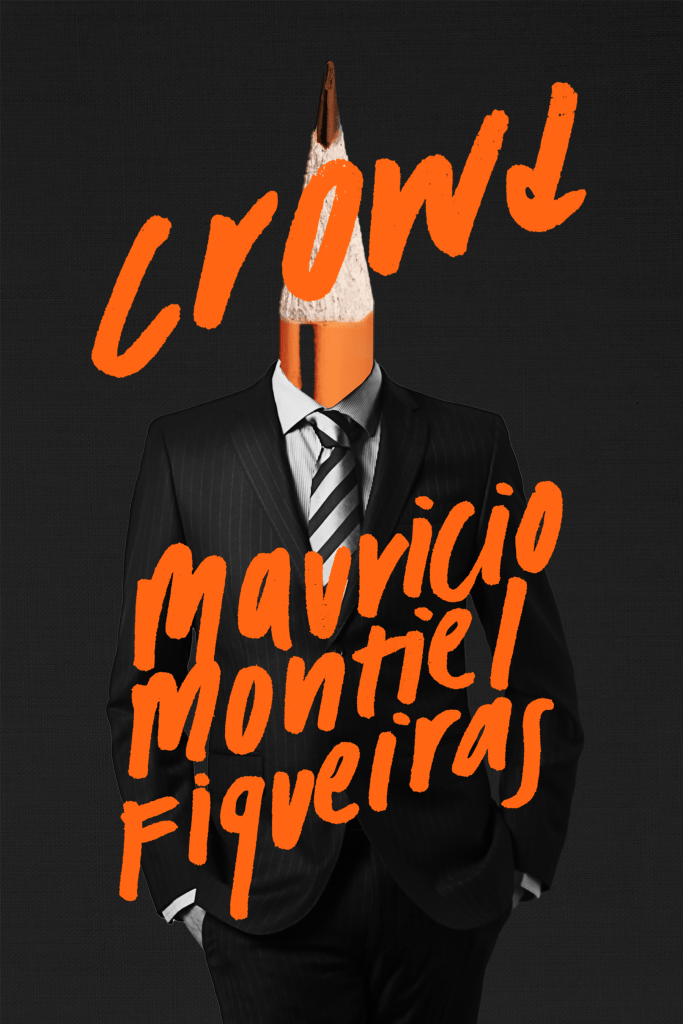
Zach Helton: I just want to start very basically by asking how Crowd started for you.
Mauricio Montiel Figueiras: Well, let me say first thing that it belongs to a novel in stories, so to speak. This is the third chapter/story of the novel and the longest one. This was a novel that was published in Spain in 2001, and its length is around 400 pages. Its title in English would be City Going Dark. It’s comprised of ten stories/chapters and Crowd is the third one. I began working on this book not in chronological order, or in the order in which the stories are arranged, and I think Crowd was one of the first ones that I wrote as an independent story. And then, when I began working on the whole project, I thought that it would be a nice addition to the novel.
So, for me, it started with this strange news that I read somewhere on the Internet about the possibility in the near future of there being the longest winters in the world due to climate change. That was around maybe 1998, 1999. As I said, the book went out in 2001. So as many of my stories begin, Crowd started with an image, this image of a prolonged winter.
And then I started working on this character, Abel. For many years I had been trying to write a sort of tribute or homage to Franz Kafka, who is one of my favorite authors of all time. I consider him to be the most important fiction writer of the twentieth century. I think that he really opened the doors to twentieth century literature in many, many ways. I agree with Elias Canetti when he says that Kafka is the most essential manifestation of the twentieth century. So I thought of my character Abel as a sort of Kafkaesque character, someone maybe from The Castle or The Trial. And I wanted to imagine this city conquered by a long winter, but also ruled by these strange and somewhat sinister companies that manufacture pencils, and that are devastating all the woods around the city, which also has to do with climate change. And from those two start points, the image of a never-ending winter and of this Kafkaesque character working as an accountant––a Kafkaesque accountant working in a Kafkaesque company––I started developing the story.
Hannah Bocz: I’m glad we’re already talking about Abel. I’m interested in how the synopsis calls Crowd a retelling of the Cain and Abel story. Did you know from the beginning that you wanted to use the characters Cain and Abel so centrally? Or when did that relationship start to make sense for the story you wanted to tell?
MMF: As a matter of fact, at the start Mr. Kane had another name. But it became clear to me as I began developing the story that I started having these mythological and Biblical images interspersed in the narrative, and it struck me that it would be a curious, strange, weird note for it to be a retelling of the Biblical story of Cain and Abel.
Actually, there’s a detail I added in the final draft before I published the story in Spain. According to some studies, Cain in the Bible had red hair, because the color red is the mark of sin, not the original sin but of the second original sin of killing his brother. So it struck me that Mr. Kane should be a redheaded character.
So it wasn’t at the beginning––it came later. It was really fun. I have fun doing the final draft of a book. The first draft is really excruciating. I don’t enjoy writing that much as other colleagues do, but I very much enjoy working in the final drafts of my story, because when I reread them I start noting details that can be rearranged for a better and strengthened narrative.
ZH: I’m noticing how much this story draws from Cain and Abel and Kafka and current events, climate change, etc. Could you talk to us about the collection of elements and ideas this story grew from?
MMF: Another fun fact for me was the idea of putting Edward Hopper paintings interspersed throughout the stories, so that his paintings became like another character in the different stories. It’s mentioned in Crowd in passing that there’s an Edward Hopper painting of an office—actually it’s called Office in a Small City. And it was really fun to think that some of the Hopper characters could have an important role in my own stories. So first Crowd is a tribute to Kafka, of course, but it’s also a tribute to all these Hopperesque atmospheres of alienation, loneliness, etc.
And the third cultural reference that really became important for me was the music by Kurt Weill that the characters are always hearing or listening to in the background, as if Weill were another dominant presence in the city and in the world of these characters.
I usually write while listening to music. Music is quite important for my writing, listening to several kinds of music, different kinds of music. My ideas flow more freely when I’m listening to music. I remember when I was writing Crowd I went to a concert in Mexico City of this fabulous German singer Ute Lemper who has sung many Kurt Weill songs with Bertolt Brecht lyrics. So after the show I started to think about using Kurt Weill to set the story—I mean it’s not a temporal story, as if it were set in a particular time of history, but the idea was that if you hear these Kurt Weill songs, you can think that maybe the story is set between the First and Second World Wars. That limbo—that historical limbo—is quite interesting for me. That’s the time when Kurt Weill and Bertolt Brechet started developing their work together, their lyrics and music.
ZH: I just looked up Office in a Small City as you were talking about it and immediately thought, “Oh, wow, that’s it.”That’s exactly how I imagined it.
MMF: Yeah, that’s actually how I visualize Abel, as the character in that painting—a man sitting at his desk and staring at the city that seems like an empty city, a ghost city, like an urban void.
HB: I want to touch on that aspect of timelessness. I was struck by the surrealism in the novella and I know from seeing some of your other works that surrealism seems to be a recurrent theme. What inspires you to keep writing in that surreal space?
MMF: You touched on a very important point because for me surrealism is maybe, as I said about Kafka—that Kafka for me is the greatest fiction writer of the twentieth century—surrealism is the most important artistic movement of the twentieth century, not only in art, but also in literature, in sculpture, in poetry, etc., and I have been studying different aspects of surrealism for many, many years now. I have written about surrealism in different aspects of the movement for magazines and newspapers. One of my favorite artists is Leonora Carrington, the British painter, sculptor, and writer who immigrated to Mexico in 1942, and her life is amazingly interesting.
So for me it is quite easy to get into this surrealistic mood when I’m writing. It’s not that I’m thinking, “Oh, now I’m going to write a surrealist story.” But also there’s this wry, dry sense of humor that sometimes gets in Crowd from surrealism. Surrealists have a great but also weird and strange sense of humor. Most people don’t catch that in surrealism, right? They think that all these artists were really solemn, always clad in metaphorical tuxedos. But I think, for example, André Breton was actually a very playful author. If you read or reread his novel Nadja from 1928, there’s a lot of black, dark humor in there. So, as I said, for me it’s quite easy to get into this mood when I’m writing.
HB: What are some things you focus on as you work from the first draft and through the revision process?
MMF: Actually, I don’t do a lot of drafts. When some colleagues come to me and say, “I’m working on the 20th draft of my novel,” I say, “Whoa! You really like reading yourself a lot because you have read that novel 20 times.” I don’t enjoy rereading myself that much so I work really hard in the first drafts of my stories. And I try to write them as close to the final draft as I want them to be. After the first draft I don’t do many more drafts, maybe two more. Then I revise—I make the final corrections on the pdf before going to print. And that’s it. That’s it because I work really hard in each story. So for me a good writing day would be like writing 2 pages, maybe 3 pages if I’m in a really good mood. I know that many colleagues can write 5, 10, 15 pages in a day. I really admire them, but then I think, well then you have to reread yourself many, many times, right?
HB: I’m really interested in the style of your writing. Many times in the novella, the narrative falls apart into this more poetic place. I’ve also read that you are a poet in addition to writing fiction. Can you talk about how you work in both forms and how you might choose between the two when you write?
MMF: I have been reading poetry for many, many years now. For me, reading poetry is almost the same as reading fiction or essays, or all the other literary genres. I started my career when I was really quite young, I mean 18, 19 years old, and I started by writing poetry, or what I thought at that time was poetry. It was really lousy and terrible. But in any case, I started writing poetry and reading a lot of poetry. And then I started reading a lot of short stories. You know, poetry and short stories are really, really close. And then I also started reading a lot of theater for maybe 10 years. I have been in discussion with many friends who tell me that theater only gets its real life on the stage. And I don’t know many people who only read theater. It’s strange saying this, but I don’t go to the theater a lot because in Mexico I still haven’t found a real connection with the scene. But in any case, for almost a decade I read theater, and that also gave me the sense that poetry, short stories and theater are quite close.
As with surrealism, it isn’t hard for me to get into this poetic style in the narrative when I’m writing fiction. And also it’s quite conscious on my part developing this style where there are long sentences. A couple of years ago a good friend and colleague of mine told me something that struck me as a revelation. He died last year, but he was a great reader and scholar––among other authors––of the Cuban poet and fiction writer José Lezama Lima. And this friend of mine told me that Lezama Lima wrote these long sentences, like long labyrinthine sentences, because he was asthmatic in real life. For me, and I think other writers, too, writing is breathing. You know, each writer has his own breathing, and I like that idea. I’m not asthmatic, thank God, but the asthmatic has to take these long inspirations for the possibility of breathing, and that’s why this friend of mine told me that Lezama Lima wrote long sentences, that it was the writing of an asthmatic person.
And I love that idea. As I said, I’m not asthmatic, fortunately, but my breathing in writing is asthmatic because of these long labyrinth-like sentences.
HB: I love that! I read about another part of your writing journey where you experimented with social media as a form and wrote some “Twitterature.” I’m curious how you see that experience impacting your style and the ideas that present themselves in Crowd in particular.
MMF: For me, social media was––it’s not anymore––was like a writing laboratory. I did many literary projects on different platforms, mainly Twitter, now X, and Instagram. So since I write these long sentences, writing 140 character sentences when Twitter started was a whole challenge for me. That changed my breathing in social media writing.
I just published a new novel a couple of months ago, The Funeral, and again it’s in these long sentences. I have done many interviews, and some of the journalists have asked me about this. You know, “Why do you write such long sentences in this era that people are used to tweets and short posts or writing short sentences?” And I say, well, I like to do the contrary of what people are doing nowadays. I have always liked to swim against the current.
But turning back to social media and writing—I worked for maybe 10 years in an expanding project that’s not finished yet called The Man in Tweed that comprises two hemispheres, as I see them––the masculine hemisphere and the feminine hemisphere. The Man in Tweed is the masculine hemisphere or the male hemisphere, and the female hemisphere is The Woman of M, who had her own account on Twitter. And on the account of The Woman of M I started developing this female voice of a character stranded in a ghost town. That idea also came from some strange news that I read on the Internet. There is a lot of strange news going around the Internet, you know, many weird things happen in our world.
And I found the story of this woman—this is real—a woman living by herself in a town in Nebraska called Monowi, a native name that means “flower.” When I read this story I thought “Wow! Here’s something worth writing about.” And if you google Monowi, you can see these pictures of the entrance of the town where there are signs that say the population. And it says “Monowi, one.”
So it’s an amazing and strange idea, of course, of a woman making the choice to live by herself in this era. And she has become pretty well known. Even the BBC did a piece on her life, but in any case, I took this idea of a woman living by herself in a ghost town, and developed a character called the Woman of M, who had her personal journal on Twitter in her account called The Woman of M. I didn’t interact with any people on that account, because well, it was a fictional character. So you know, fictional characters can’t talk to other people. Only through the page or in dreams.
That was the female hemisphere. And the male hemisphere, the Man in Tweed, his novel comprises three expanding parts set in different settings––an unnamed city, an unnamed island and Venice, but like a Venice that is mixing different times. I call it a simultaneous Venice, because you have elements from the eighteenth century, the nineteenth century, and the twentieth century in the same city, in the same Venice. Each part is also set in a different season of the year––spring, summer, autumn, and the last part is actually going to be set in winter in the ghost town of the Woman of M. The two characters are going to finally collide. They have been separated in social media, but in this fourth and last part they are going to finally meet each other.
It was really fun writing this project. As I said, it has been expanding. The three parts of the novel, plus the journal of the Woman of M, plus the journal of the Man in Tweed, I think is more than a 600-page-long project right now, and I still have to write the final part. It was really fun while it lasted.
ZH: As we close, is there anything you wish we had asked you about Crowd or about writing in general?
MMF: Well, as I’m doing the last reading of the pdf—it’s really strange rereading yourself after many years of writing something—I’m struck by this obsession with crowds, either mine or Abel’s, the main character.
Maybe it was because of the epigraph by Bill Buford. I read Among the Thugs, this really great book about how Buford followed a group of British hooligans for I think one year in different settings, not only in the United Kingdom, but also for example in Italy. That was maybe 1990, I think 1991, something like that. It’s actually like a horror book, because of the violence and brutality that characterizes the hooligans. It struck me really hard. So maybe reading that book was when the interest or obsession with crowds became the main thing I invented to characterize Abel, to make him just another one, a nobody that only when he’s part of the crowd becomes somebody.
ZH: That’s excellent. Thank you. Thanks again for making this space and talking to us.
MMF: No, no, thank you for the really smart questions. Thank you very much.
 Panhandler Books