Proper Imposters – Forthcoming January 2025

Jason Ockert Interview
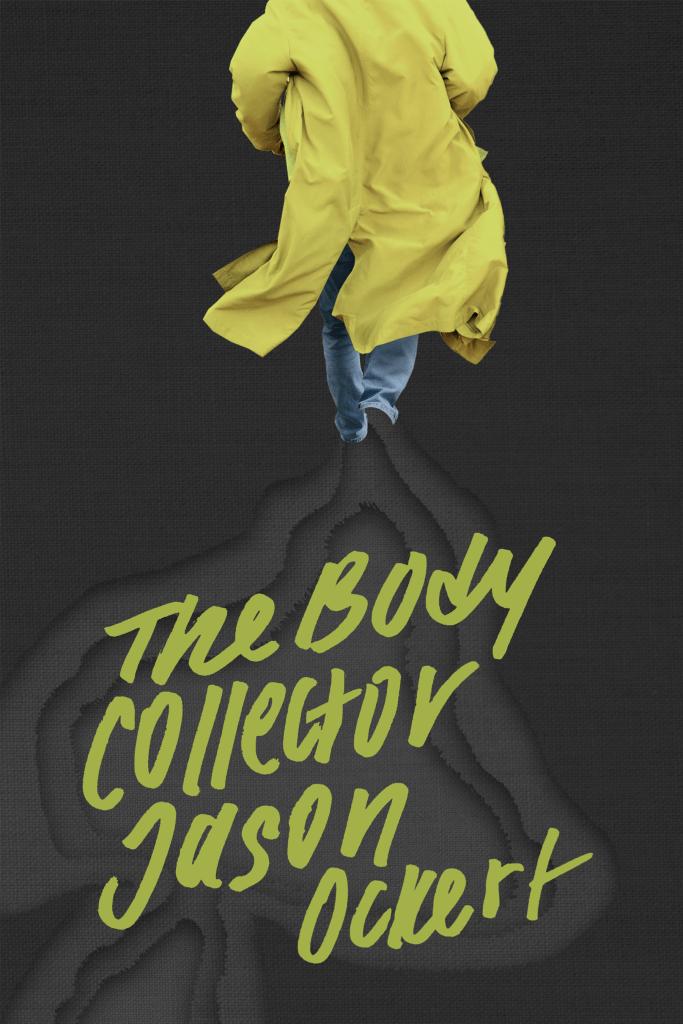
Hannah Bocz: Thank you so much for talking with us. It’s a pleasure.
Jason Ockert: It’s my pleasure!
HB: So, the main conceit of the novella surrounds weight loss. How were you inspired to use weight loss to such a phantasmic extent with The Body Collector?
JO: Good question. I write by exploring a series of problems and possible solutions. It didn’t start with me saying, Here’s a theme I want to speak to! Instead, I started with a desire to wade into unfamiliar water. I like treading in places where rules are murky and there’s no vaster mystery than the one enshrouded with death. Duncan became the vehicle for me to dive deeply into liminal space.
The obesity epidemic is something I’ve thought a lot about. Epidemics, in general, have been on my mind ever since the global pandemic. I can’t say exactly why, but when I first started sketching Duncan out, I envisioned him as big. It was a facet of his character, of course, not the entirety of it. He is many other things than “large.” As I tried to inhabit his headspace, I eventually started asking some questions. Namely, how do others see him and how does he see himself? The answers to those questions morphed into “themes,” I suppose. The push and pull of body image. The billion dollar dieting industry is omnipresent. People are constantly coming up with new ways to lose weight and some of them are extreme. So, I played around a little and came up with the Flavor Eraser, or “tongue condom.” On the surface, it’s absurd, but if you think about it a while it’s not so far-fetched.
Zachary Helton: Absolutely. The “tongue condom” reminded me of a diet aid from the eighties that literally deadened the taste buds on your tongue, so eating no longer gave you pleasure. The dieting industry is intense.
JO: Yikes! I didn’t know there was an actual product that did this. It probably worked, to an extent. All of these things work, to an extent. Our body is, for the most part, pliable. It’s our brains that don’t always do what we want them to do.
ZH: So, speaking of the dieting industry, The Body Collector did a great job exploring the shame-driven culture we’re in. We try to define ourselves by negatives—by not being addicted, by not being overweight—but your story seemed to imply that while addiction is no way to live, just being not addicted is no way to live either. There has to be some kind of positive definition. I wonder if you could speak to how you saw that playing out in the story.
JO: I appreciate you saw that because that’s what I was aiming for. To me, nothing is interesting or new about the idea of feeling ashamed about the way you look because you don’t meet a preconceived idea of how you should look. It’s an awful way to live and yet that societal pressure has been around as long as I can remember. And I don’t imagine it’ll go away anytime soon. What I wanted to do in this novella is dive into the particulars of the character. I think an individual can overcome damned near anything. With help, of course.
One interesting attribute of the novella is that it allows you the space to let secondary characters take on much more of a role than they might in a short story. So, when I realized this wasn’t just Duncan’s story, I leaned into Donna. She became the gateway into my understanding of Duncan. She became a possibility for a broken man to be a little less broken. A chance at human connection.
ZH: I appreciated what you did with connection. It felt like an excellent move to have Duncan’s job be in remote sales, where he spoke to people all day and connected with no one.
JO: You know, I was writing this around the time of COVID-19, amid all the isolationism we experienced. This story was definitely looking at some of the strange things that went on in those private spaces of whatever personal struggle we as individuals were having.
There’s a danger in isolationism. On one hand, the danger is external, as in, If you don’t get healthy, you might have a heart attack. Or, If you don’t wash your hands, you may get COVID. It’s a warning that’s either heeded or not.
On the other hand, there can be an internal danger lurking under the surface when we separate ourselves from others for too long and stay submerged in our habits. All the doubt, insecurity, and gluttony that resides in our worst selves is tempted to seize us. Pull us into dark places.
Part of the hope in this story is that Duncan did find the strength to get out of his damned apartment. He did climb all those damn stairs. He clicked off all those damn lights. He made the effort to improve his lifestyle. Of course, trying hard doesn’t mean you won’t be haunted by your former or future self…
HB: You’re talking about these relatable aspects, like Donna’s anxiety and Duncan’s struggle. One of my favorite moments in the novella is when Duncan writes on the board and tells his story. That’s one of the most fantastic parts—his death and the deal he makes with the Body Collector—but when she responds, she says his story seemed normal to her. I wonder if you could talk about that moment.
JO: Part of the reason I’ve continued to write all these years is because I’m still curious about people. I mean, in general, they suck. But individuals? They’re infinitely surprising and often quite beautiful. Donna’s life is in a rut and Duncan jolts her out of it. She sees the broken parts of him, and realizes that they’re not exactly the same broken parts in her and so—and this is all subconscious—she is attracted to him; psychological warts and all!
Structurally, the leap into first-person was a major risk. My feeling is that first-person can be unreliable and, as such, you have more liberty to explore strange ideas, like the Body Collector. Ideally, when I transition out of Duncan’s confessional story, your interest is piqued. If I’ve written it well enough, I can encourage you to try and make sense of it for yourself, too, when we’re back in third person.
ZH: That worked really well for me. If you’d told that story about the Body Collector in the third person, there would have been more credibility to it, whereas when he’s writing it all down, you don’t know if it’s real or not, and character-wise, it doesn’t really matter.
JO: Yes, thank you.
ZH: To change directions a bit, I wanted to ask about death and resurrection in The Body Collector. There’s a lot of death and resurrection, but not in the way it’s usually depicted. You tell this story where, when the old self dies, resurrection isn’t necessarily a straightforward process. It might actually be quite horrifying and have to happen multiple times. I’m wondering if you could speak to that—to what you were doing with death and resurrection in The Body Collector.
JO: When I write about Big Ideas, I know that I’m probably not getting them right, exactly. That’s fine with me. I don’t think that there is a single “right” when it comes to post-life. Instead, what I can get right are my characters. For better or worse, Duncan is my creation. As long as I’m fair with him, and fair with the reader, I feel like I can go wherever my imagination wants to lead me. In this story, that was into and then out of death via a character whom nobody thinks has anything meaningful to say about that journey. Imagine solving the riddle of death and nobody bothering to ask you about it?
It fascinates me that we’ve become somewhat inoculated against death. You can see this specifically in the gaming world. In games, we die and are resurrected all the time, right? A little version of us just goes away, but hey, then we get to start over again. So, if we look at death as temporary—which, maybe it is and maybe it’s not—how does that influence the ways we actually live? That’s the fate I’ve drawn up for Duncan. At first, he’s cavalier about death—like many people are—but the first near-death experience spooked him. He decided to change his lifestyle by adjusting his deathstyle.
The thing is, we are multiple selves. You were once six-years old and enthralled on a swing. While you’re not capable of replicating that childhood thrill, at one point in your life it was real and you felt it. On the flip side, you’re going to be someone else very soon. Like right…now! We’re always in flux. It’s hard to be present. What I love about writing, and art in general, is that it is fixed. It rages against temporality. Stories are immortal.
HB: Something I appreciated about The Body Collector was how lighthearted it felt. There’s so much humor that I was just enjoying reading it despite those heavy life-and-death themes. I’m wondering how you balance the humor with those heavier ideas.
JO: Oh, I think that’s necessary to do when I write. My chief aim is to try to evoke an emotional response and I’ve discovered that one of the “easier” ways to get that response is through humor. If I can get you to laugh, then I can get you to let your guard down. Then, ideally, if you trust me, I can try to guide you to a “higher shelf” feeling. Like loneliness or perseverance or love.
ZH: I know we’re past time, so I’ll close by asking if there’s anything you wish we’d asked about—about The Body Collector or writing in general.
JO: Oh sure. I do want to say how exciting it has been working on this project. There isn’t a book quite like Proper Imposters. And there aren’t better, more dynamic writers working in the form than Mauricio, Jeff, and Chaya. I’m grateful to be in such talented company.
HB: Well, thank you for your time. We appreciate you talking to us!
JO: Of course! It’s been my pleasure.
 Panhandler Books