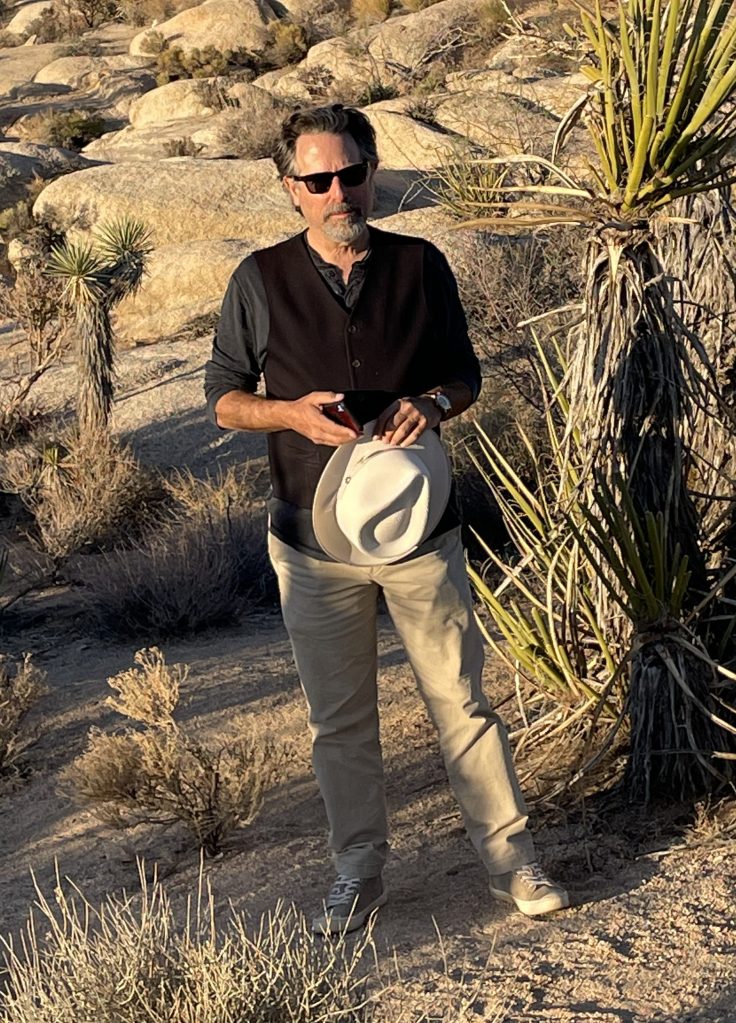
Joseph Skibell (pronounced SKY-bell) is the author of five previous books, including the award-winning and critically-acclaimed novels, A Blessing on the Moon and A Curable Romantic. He has received numerous awards, including the Rosenthal Foundation Award from the American Academy of Arts and Letters, a National Endowment for the Arts Fellowship, the Sami Rohr Prize in Jewish Literature, and the Turner Prize.
His work has been described as “confirmation that no subject lies beyond the grasp of a gifted, committed imagination” (New York Times); “witty and profound” (Jerusalem Report); “laugh-outloud humorous” (Forward); “brave … unafraid” (New York Journal of Books); “magical” (New Yorker); “high-energy, wild” (New Republic); and “wholly original” (JM Coetzee).
Skibell’s stories, essays and articles have appeared in The New York Times, The Wall Street Journal, Commentary, LitHub, Tablet, the Utne Reader, Tikkun, Fretboard Journal, and many other publications. The Winship Distinguished Research Professor in the Humanities at Emory University, he was, for a decade, the director of the Richard Ellmann Lectures in Modern Literature. When he’s not teaching, he lives in northern New Mexico.
What Music Really Is
– a continuation, excerpt 2, from Dr. Bopstein and the U.S. Dept. of Dreaming, a novel by Joseph Skibell
(Read Part 1, “Acancy,” for context and continuity)
“Gentlemen, gentlemen!” the bartender cried out. He was onstage now, the Brylcreem in his black pompadour shining in wavy white lines beneath the hot stage lights. He had taken a microphone off its stand, causing it to emit a sharp shriek. “Gentlemen,” he had to say it again in order to quiet down the crowd. I guess men don’t really come to bars to listen to the music, do they?
“Life often gives you things you could never anticipate, moments that seem almost dreamlike in their unreality, and tonight, if I didn’t know who I was and who you all are and where we all were, I might imagine I was dreaming. However, thanks perhaps to the weather or to our proximity to the road or to forces none of us can comprehend, we have received two visitors tonight, one a well-known musical innovator, a Verge and Savoy recording artist, and the inventor of bebop …” and here, a tear almost came to my eye, children, as I thought he meant me and that someone had finally gotten the billing right, but then, of course he added, “… and the other, his faithful brass companion, the good Dr. Bopstein! Please welcome to our stage tonight, to be accompanied by our very own Small World Band … Mister! … Disney! … Gillespi!”
As the applause rang out, Diz grabbed me by the throat, and I could feel his shoulders tensing up at the mispronouncement of his name. He didn’t seem to care about all the other misinformation Carl the bartender had gotten wrong, but what could either of us do? It was time to kick some brass and take some names, and no way were we going to let those Disney brothers put a deeper dent into our moods!
But of course, there were a couple of things neither of us had counted on.
Number one: by then, I was tripping what, if I only had them, would have been my balls off, although I didn’t have that nomenclature for what was happening to me at the time. My first indication that things maybe weren’t normal was a slight tingling along my piping. I felt restless, though alert, and also, no pun intended, a little dizzy.
Was I drunk? On one stolen mojito? Granted, it was the first alcoholic drink I’d ever had, and although I felt a little intoxicated, this new mindset didn’t seem to be the work of one probably watered-down alcoholic drink.
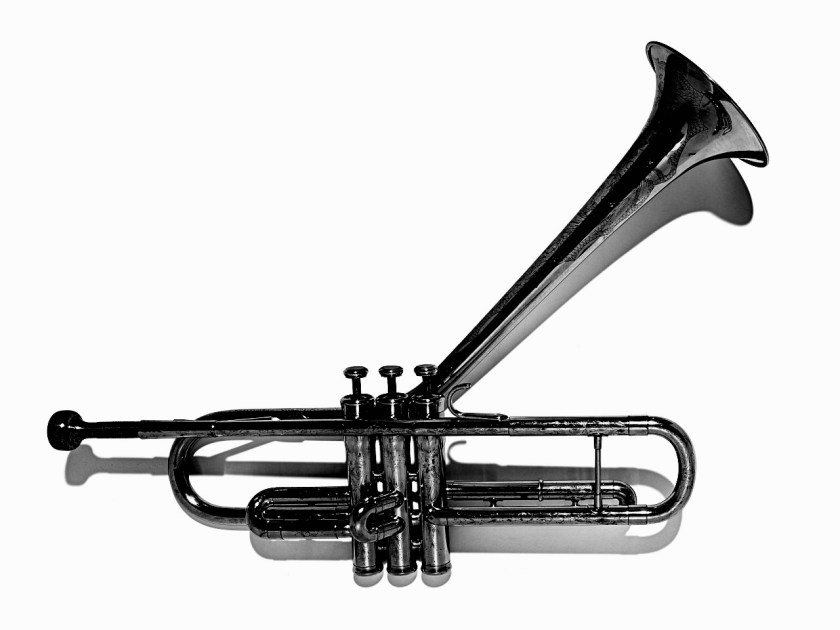
Meanwhile, Diz was bounding onstage, all buoyed up by the applause, which sounded genuinely enthusiastic. This wasn’t Kaycee, but it was in close proximity, and maybe a few of these cats still knew what was what jazz-wise. I wasn’t so far gone that I couldn’t assume the position, turning myself into a playable trumpet, even if one with my distinctively raised bell, and that was another thing: unlike alcohol, whatever I’d ingested hadn’t affected my motor skills.
I looked at Diz, Diz looked at me, and as we stared deeply into each other’s valves, inside the eyes of the little homuncular reflection I could see of myself in them, I could also see the faces of all my ancestors, one inside the eyes of the next, horn after horn after horn, all the way down the line to that great-great-great-grandfather, the ram’s horn carried by that priest in the kingdom of Israel way back in 300 BCE, each one of them taking it all in, and all of them, I suspected, pretty much thinking the same thing: What the fuck we doing in a dive like this?
They were, after all, used to playing in sacreder precincts.
(And I had to wonder if Diz wasn’t seeing his long line of Yoruba shamans reflected in my valves as well?)
Diz wiped his brow with a white kerchief, the folds of which seemed to be standing out in an iridescent chiaroscuro. I had to shake my head to come out of the trance the image produced in me, and I’m telling you, children, that image seemed eerily precise, the blue-grey shadow from the raised folds falling across what looked like a pristine valley all covered with snow.
And then, as Diz did that thing, turning his profile to the audience while cradling me in one arm, snapping his fingers to count in the beat, everything seemed to slow down, and it gave me a chance to take in the Small World Band, or the SWB, as it appeared, from the front of the drum kit, they were called, and goddamn if they didn’t look like the whole motherfucking world in miniature.
The pianist was a Chinese dude, and the drummer was an East Indian Indian, you know what I mean, an Indian from India. The bassist was a turbaned Arab, and the guitarist looked Mexican or Inca or Aztec with a finely chiseled nose, and then, there was a guy who looked Scandinavian playing the vibes with mallets, and of course, there was Diz and myself. All that was missing was an Eskimo from the Arctic and a scientist from Antarctica and every continent on earth would have been represented.
Am I dreaming, I thought?
However, before I could blink my dilated mother-of-pearls, before I could shake the sawdust out of what, if I had one, would have been my motherfucked-up head, Diz called the first tune.
“‘When You Wish Upon a Star,’” he said. “No head. Double time! Let’s play it fast and loud for these Cuban motherfuckers!”
Now, this is what Fish, our manager, had recommended to Diz way back at the Village Vanguard. It was only half a week ago now, but it felt like forever, and of course, it was an old bebopper’s trick. Dig this, you take a famous tune, say, like the Gershwins’ “I Got Rhythm,” and you just don’t play the melody or what we in the music biz like to call the “head.” Instead, you dive straight into your improvisations, the cats all know the changes, no one’s got to rehearse, and then you slap a new name on the tune, which is now unrecognizable to the listener, and even more important, to the copyright owner, to whom you owe not one red cent.
Ah, so, this is how Diz is going to get around the restrictions of that contractual stipulation that we play only tunes from the Disney Studio’s expansive repertoire, I thought.
He put his lips on my tailpiece, and I can’t begin to tell you how exquisitely pleasurable that was, nor should I. (Some things between an instrument and his stagehand have to remain private.) But then, things began to get a little weird. First off, everything in my visual field – the stage, the crowd of fedorable men surging towards it, the long bar at the back of the room – began to distort. It was as though I was looking at everything in an undulating funhouse mirror. I tried to steady myself by searching for the reflection of Diz and me with the band behind us in the actual mirror behind the bar, but the Cuban flags draped over it had all begun to wave as well.
Fantastical, kaleidoscopic images came in towards me in alternating patterns, opening and closing in circles and spirals, before exploding into colorful fountains, rearranging and hybridizing themselves into a constant flux. Every acoustic perception – a brush on a drumskin, a patron’s glass tinkling – translated into an optical perception, and everything seemed animated by an inner sense of restlessness. I wanted to leap out of Diz’s arms and scream, but instead, I felt the air of his breath whooshing through me, and I knew I had to sing, children, and I did.
I sang, the notes starting out as small dots, then tiny black circles that grew bigger in front of my eyes before combusting into flames of color and light, and these burning, blistering notes, so far from anybody’s idea of a Disney tune, soared over the heads of the men before dropping onto the dance floor and igniting its boards in bursts of flame. I watched, fascinated, as the fire leapt from the floor to the walls of the bar until eventually even the ceiling was burning.
“Dig it, baby!” I heard the drummer say before his voice turned into a lone seagull that flew off somewhere overhead.
And now, there was nothing I could do but open my throat and let out whatever was in me, and so, I was really singing, babies! I was singing, and I was swinging, and I think even Diz was taken aback by the power, the ferocity, the tenderness, and the innocence of the voice the two of us were making together.
And the band, man, those cats, sparked by the freedom in our sound, were grooving like I’m sure they’d never grooved before!
I’m telling y’all, there was nothing Mickey Mouse about this so-called Disney tune!
Diz called for “Whistle While You Work,” and the band effortlessly switched gears, and the feeling amongst us became a little mad, and I was feeling a little crazy myself. I was still in tune, but I was shrieking, and the music, the song, was full of anxiety and tension now, as bebop sometimes is.
As I’m sure y’all know, it’s no coincidence that Belle and I invented bebop back in the 1940s and 1950s, in the wake of all the violence and the destruction of the war and the atomic bomb and everything like that, back when quantum physics was telling you, so that even the man on the street knew it, that nothing was as it seemed.
I looked at the drums, and they sounded like bombs dropping on cities. I looked at the vibes, which sounded like skeletons dancing to me. The guitar, fretting its hour upon the stage, was wailing like a woman whose children have been swept away, and you could even hear the thundering agony of dying elephants in the pounding of the piano’s ivory keys.
Me, I was on the point of weeping, the pain and the beauty of it all was too much for me, when suddenly –YEOOOWWWZER! – Diz did something with his tongue, which I don’t even want to describe to you, children, because it wasn’t really decent!
And now, it’s my turn to take a solo, and I’m burning up the motherfucking stratosphere. It’s all fire and ice, burning and not burning, freezing and not freezing, each note an atom with a little humming electron and proton of fire and ice singing inside its nucleus, and if you could only look into it, you’d see a microscopically small cotilion of whirling dervishes dancing Dhikr, while the neutrons are buzzing around it with the sound of a neon sign on the fritz.
At that point, I couldn’t tell you where I started and where Diz left off or vice versa, because we were one, one being.
Diz didn’t even have to call out the next tune, or maybe I missed it, but the whole band, by then attuned to our every thought, segued as one into “Chim Chim Cher-ee!” and I’ve got to tell you, kids, what I saw in that moment is something I’ve never be able to unsee.
At that point, I was really blowing, and Diz could barely keep up, and in the heat of the moment, with all that lysergic acid threading through what would have been my veins and capillaries, each micro-dose surfing its own platelet through the choppy waters of my plasma, I started losing sight of all those Hawaiian-shirted Legionnaires or Mormon missionaries or dentists or whoever those fedoraed motherfuckers were, though I could still feel their presence, I could still feel them hanging on to our every note as though I was my great-great-great-to-the-whatever-power-grandfather, the ram’s horn, and Diz my stagehand Joshua, as we f’it the battle of Jericho, all of them waiting for those holy walls to come tumbling down, and I’m talking about the walls between themselves, for sure, children, but also the walls inside themselves too, the corpora callosa keeping their right and their left brains segregated as well as the septa inside the crooked zigzaggery of their hearts.
And by then, dig it, Diz, my faithful amanuensis, had lifted me up high, high, high into the air, pointing me towards the Heavens, and I’m singing my own crooked little heart out and finding little hidden pockets in the scale I never knew existed, and those Legionnaires or missionaries or whoever those motherfuckers were wouldn’t let us end the set.
No, now they’re conking along in a conga line, winding in a convulsive chain around the tables in front of the bandstand, like a double-helix winding around itself, snaking like a python through the tables and the chairs, and every eight bars or so, they shout out “Aye!” like in one deep masculine voice, every man throwing out his arm in formation, first the right arm, then the left.
Well, there must’ve been forty, fifty, sixty cats, something like that, and as they gathered Diz and me off the stage and into their conga line, the band kept wailing to that Cubano beat. Someone playfully ripped Diz’s beret right off his head and replaced it with a straw fedora that was too small for him, someone else threw a Hawaiian shirt onto his shoulders, but it fell onto the floor when, because of how hard I was blowing, Diz had to throw his head back.
And now Diz and I are at the front of the conga line somehow, and all them cats are following us, and it’s steaming hot inside that bar, although you can see outside the windows that the snow is blowing almost sideways, like rice being thrown at God’s wedding, all the tall lights out in the parking lot seem illumined by halos, and those lightbulbs flashing on and off on the Alef sign, one bulb chasing after another, make it seem like the giant Alef in the center of the sign is moving and dancing and grooving to the beat.
And I don’t know how it happened, but just like that, children, somehow the music is way behind me, as though it’s being played inside the building, while I seem to be standing outside in that snowy parking lot, with the snow looking like a television set after the broadcasting station has signed off for the night, which is probably an image y’all are too young to conjure up.
And something in the dark sky attracts me, and I squint my valves up, and I see that it’s a flock of winged cornets, half-bird, half-horn, flying towards the motel in a jagged V-shaped formation.
“Well, well, well,” I say, as they land at my feet, chirping and chattering and skittering around in the snow.
“Come with us,” they say, “and we’ll show you.”
And something about them is really making me laugh. “Show me what?” I say.
And the truth is, they’re not speaking with words, they’re singing notes, but nonetheless I can understand them. For one thing, music is a universal language, and not only do I happen to speak it, but it’s my native tongue, and for another, and maybe I should have mentioned this earlier, all knowledge is contained in the 12 notes of the musical scale.
Human knowledge, but also animal, vegetable, mineral, and divine knowledge as well.
“Come with us,” they tell me, “and we’ll show you what music really is.”
Well, I look through the windows of that burning bar, and I see that the fire is still licking the walls and the floor and the ceiling, that conga line is still convulsing in the middle of it, with Diz and me at its swirling center, and I’m reluctant to leave, I’m reluctant to leave all these jovial companions of mine, Diz especially. I mean, God only knows how he’ll manage without me!
But these winged cornets, these little chirping bird-horns, are so sweet and playful, so gentle-hearted and ticklish, they’re nearly impossible to resist, and at the same time, if I’m being totally honest, they’re also kind of insistent, though in a charming and seductive way that kind of conceals the fact that they’re pushing me.
You know, they’re making all these chirpy little cornet jokes, things that only a cornet might find funny.
And like what, you’re probably wondering?
Well, like, “Aw, don’t B-flat,” and “In the Middle C of our life’s journey, I found myself in a dark wood,” which is a reference to Dante, or “Who left the hot Chopin on top of the Beethoven?” and as you can see, they’re not that funny, but for some reason, they’re cracking me up. I mean, I guess you had to be there, but as far as I was concerned, I was there, and the next thing I know, I’ve given in, and now I’m flying too!
I look down, and from the air, I can see the Kaiser out in the parking lot, underneath the blue shadow of the Alef sign. I can see the Alef Roadside Motel & Travelers Lodge, all in flames now, surrounded by a snowy field that seems to stretch for miles. The roof has burned almost completely off, and from far above it, I can see into the bar where that conga line of straw-hatted men is still wheeling around Diz and me, and somehow, I don’t know how, but I know that me and the cornets are headed east, flying back over the route Diz and I spent the last couple of days driving.
And before I know it, these little winged cornets have flown me all the way back to the entrance of the Martin Factory in Brooklyn, my birthplace, if you will, or the place of my manufacture.
“But what are we doing here?” I ask them, standing there and looking up at the monstrous locked gates of the factory. A wind is howling, and through the bars of the gate, I can see black smoke billowing out of its smokestacks.
“But you know why we’re here,” they tell me. “It’s you who’ve brought us here, not the other way around.”
They speak all at once, though it’s not jumbled, which is something only musical instruments can do.
“This place is so lonely,” I mean to say, but the word comes out simultaneously as both lovely and lonely. “And anyway, let’s go back. I’ve changed my mind,” I tell them, but the words come out as I’ve chained my mind, and the little cornets all titter, dancing around in the snow, leaving little bird-like footprints.
And I got to tell you, children, it’s almost like I’m seeing the words, or rather it’s like the notes on a musical staff have been written in the air between us, and no sooner do they appear than they turn into the kind of clouds of breath you might see on a cold wintry day, after which they evaporate.
“Follow us,” the little cornets say, and though at this point, I’m pretty much spitting in my pants – we trumpets do have spit valves, you know – the great gates of the factory creak open, and I follow the cornets as they hop and flutter across the desolate factory grounds, and when they slip in through an open door, I follow them into one of the factory’s main production rooms.
And oh, children! It’s full of machinery, and all of it’s operating with the sound of a massive industrial roar.
“What is it you want me to see here?” I ask the little cornets, but they don’t answer me this time, or maybe I just can’t hear them over the factory’s rumbling clamor. Instead, they lead me to the end of what appears to be a long assembly line, where I see a recently manufactured trumpet lying on a large chamois cloth, and of course, I recognize that trumpet as myself.
“Why, it’s me!” I say.
“Mi, mi, mi,” they twitter, as in do, re, mi, laughing their little asses off.
I take a step closer to myself, lying there on that chamois at the end of the assembly line, all complete and newly manufactured, gleaming, without a dent or a scratch or the dull tarnishing that a lifetime of fingerprints leaves upon a well-played horn.
“I was so young!” I say. “And so beautiful!”
But then, as I stand there, looking at myself, suddenly, my perceptions begin running like a film in reverse. I see a workman walking backwards towards me, and I watch as he picks me up and unpolishes and unlacquers me, and with every backward scrub of his cloth, I become less and less gleaming.
Another worker, his tools running counterclockwise, disinstalls my finger-ring from my slide, after which someone else, running a little tube of lubricant up and down my piping, unlubricates my three pistons with the lubricant returning inside its tube.
Another worker disengages my valve casings, and then, someone else, with protective eye-gear and a flame, slowly unsolders my bell.
Then I’m laid on a wheeled table with a bunch of other frozen horns, and with the cornets hopping around my feet, I watch as, in reverse, the frozen soap-water solution inside each of us unfreezes and rises out of our open mouths, falling upwards, so to speak, into a plastic pitcher.
And even though I’m standing apart from all of this and watching it, I can still feel it. It’s like it’s me and not-me at the same time.
Eventually, I’m turned backwards on a lathe, my rim unheated and unrolled, and I watch as a worker’s mallet glances off me, unstriking and unshaping me. I’m unfolded and uncut, unscored and untraced, the workers’ tools running over me, leaving me less and less a trumpet, until eventually, I’m nothing but a flat piece of brass just lying there on some anonymous worker’s bench before he seems to roll me into a cylinder and, walking backwards, places me on a shelf with other such cylinders.
And in a kind of climatic explosion, I watch as that piece of brass disintegrates into its constituent minerals, which are then unmined by miners, also walking backwards, whose job seems to be to shovel everything back into the earth, and then, my vision pulls out, and I see the Earth itself, this blue-green ball hanging on nothing in the middle of empty space, rotating backwards on its axis, unreeling and unspooling, and getting faster and faster, as it heads towards the first syllable of unrecorded Time, and the whole thing disappears.
And that’s when it hit me, children, that’s when I realized I was more than just a hunk of metal, I was more than just five or so pieces of manipulated brass. A trumpet is a trumpet because it sings, and at the core of my being, I realized that I was nothing but song, and that song is nothing but breath!
And that idea kind of tore a hole right through me, and that’s when one or more of those little winged cornets looked up at me, all chittering and chattering away, and said, “And now you know, now you’ve seen it for yourself, Bop, and now you know what music really is.”
 Panhandler Books