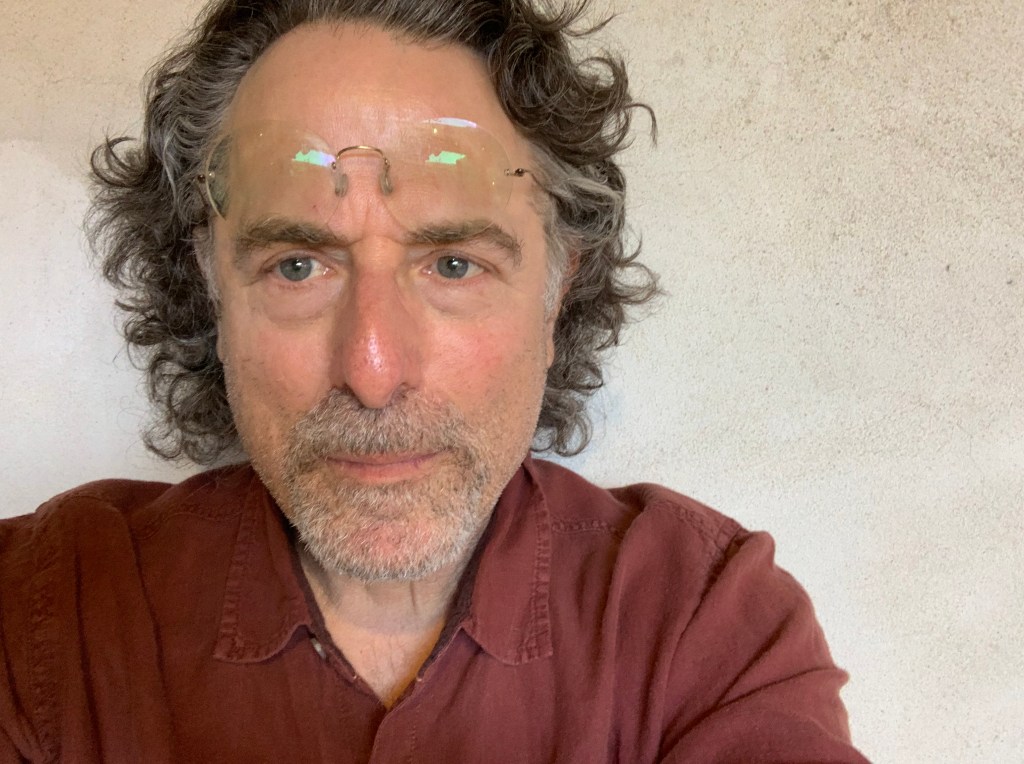
Joseph Skibell (pronounced SKY-bell) is the author of five previous books, including the award-winning and critically-acclaimed novels, A Blessing on the Moon and A Curable Romantic. He has received numerous awards, including the Rosenthal Foundation Award from the American Academy of Arts and Letters, a National Endowment for the Arts Fellowship, the Sami Rohr Prize in Jewish Literature, and the Turner Prize.
His work has been described as “confirmation that no subject lies beyond the grasp of a gifted, committed imagination” (New York Times); “witty and profound” (Jerusalem Report); “laugh-outloud humorous” (Forward); “brave … unafraid” (New York Journal of Books); “magical” (New Yorker); “high-energy, wild” (New Republic); and “wholly original” (JM Coetzee).
Skibell’s stories, essays and articles have appeared in The New York Times, The Wall Street Journal, Commentary, LitHub, Tablet, the Utne Reader, Tikkun, Fretboard Journal, and many other publications. The Winship Distinguished Research Professor in the Humanities at Emory University, he has taught at the University of Texas, the University of Wisconsin and Bar-Ilan University. He was, for a decade, the director of the Richard Ellmann Lectures in Modern Literature. When he’s not teaching, he lives in northern New Mexico.
October 3, 2025
Grace Maxwell: You’ve been writing for many years, and you’ve published several acclaimed novels, A Blessing on the Moon and A Curable Romantic among them. What drew you to fiction as a form?
Joseph Skibell: Well, when I was in junior high, I read Anthony Scuduto’s biography of Bob Dylan. And in it, as a kid, Dylan reads Steinbeck’s Cannery Row. And since, when I was growing up, I wanted to be Bob Dylan, I thought, Well, I should do everything Bob Dylan did, and so I also read Cannery Row. And in the biography, Dylan was so turned on by Cannery Row that he went on to read all of Steinbeck’s work.
And that’s what happened to me: I was so turned on by Cannery Row that I read all of John Steinbeck, and by the end of it, I didn’t want to be Bob Dylan anymore; I wanted to be John Steinbeck.
But that was kind of daunting because I remember thinking that I didn’t know the kinds of things that a novelist apparently has to know. I don’t know how to clean a horse. I don’t know what wainscotting is. I didn’t know how to clean and oil a gun. But then, somewhere in there, also in junior high, I read Voltaire’s Candide, and I thought, Well, I could do that, you know? (laughs) I mean, there were no descriptions of rooms in Candide, nobody cleaned a horse, nobody dismantled and oiled a gun.
But still, the thought of writing a novel was still too scary to me, and in college, I started writing plays because I had a facility with dialogue. And also, when you read a Harold Pinter play, for instance, often the stage directions just say, “a room,” and you don’t even have to describe the room. You don’t need to know what wainscotting is, and I thought, This is great!
So, I wrote plays, and then some producers who worked with John Malkovich became interested in a screenplay I had written, and believing I was on the lip of outrageous fortune, I moved to LA with my then-girlfriend Barbara Freer, who is now my wife. At one point, I just started writing short stories. And one day, Barbara came into the little study I had in our little apartment, and she looked over my shoulder, and she noticed that I wasn’t writing a screenplay.
And she said, “Why are we living in LA if you’re not writing screenplays?”
She didn’t really like living in LA.
So, I went back to writing screenplays, but I had these three short stories that I’d written before Barbara busted me.
Eventually I did get professional work, writing a screenplay for the son of a really famous actor, but that only convinced me I wasn’t really suited for screenwriting. I was trying to figure out what to do with my life, and a friend of mine, a playwright and a screenwriter named David Mark Cohen was part of the faculty that was starting what was then called the Texas Center for Writers.
David came to LA, and he said, “You know, if you’re really thinking about going to graduate school, you should come to us. We’re a multidisciplinary program, and you’d be a perfect candidate.”
The novelist James Michener had given $13 million to the University of Texas to fund the program, and this would be the program’s first year with a cohort of students, and I applied as a playwright-screenwriter. Back then, you had to apply in two genres, a primary genre and a secondary genre, and for a moment, I considered applying as a playwright-fiction writer, but I felt more secure, more competitive as a dramatist.
Still, I got in, and when I arrived there, the first event they had for us was a short story workshop with a writer named Christopher Tilghman, and with a lot of trepidation – and just wanting to participate, really – I submitted one of those three short stories Barbara had busted me on to the workshop.
And that was a complete revelation for me because I saw that my short story wasn’t really any better or any worse than the stories of the people who’d gotten into the program identifying as fiction writers, something I hadn’t had the courage to do.
That was really liberating. It really made me think that maybe I could write fiction. And so, I changed my focus and started writing fiction, and immediately I had more success with fiction than I did ever did as a playwright or a screenwriter.
My brother Steven Skybell (he spells our name with a Y) is an actor, and we were once out to dinner with a lot of people at a restaurant in New York, and I noticed that he was very comfortable holding forth to the whole table, while I’m more comfortable leaning over to the person I’m sitting next to and talking privately one on one, and it occurred to me that that’s the difference between a playwright, or a theater person, and a fiction writer—a fiction writer talks to one person at a time, while an actor or a playwright addresses a crowd.
And so, though it took me a long time to realize it, writing prose, writing fiction was just a more natural fit for me. And what I also discovered, much to my delight and surprise, was that when it came to describing rooms and clothes and automobiles and physical things, I actually love doing it, and I have much more of a natural facility for metaphor than I ever imagined, and that’s something you’d never be able to employ much as a dramatist.
In any case, that’s the really long story.
GM: It’s interesting that you said you found that you were actually very good at writing dialogue. I feel like a lot of writers struggle with dialogue the most. So, was that just always natural for you? Do you envision conversations? Because making the dialogue sound natural and not forced, that’s the hardest part. What’s your process?
Years ago, as part of my training to teach in the UCLA Extension Program, I took a class with a novelist named Kate Braverman – she wrote a book called Lithium for Medea – and I remember her saying, “If you put a gun to Garcia Marquez’s head and said, ‘Write a realistic-sounding line of dialogue or die,’ he would die.”
Joseph Skibell
JS: Well, I did write a lot of plays and a lot of screenplays before I started writing fiction, and I was always interested in how people speak and also in how we misspeak. I’m still interested in how little is conveyed in the actual text that is spoken in, for lack of a better word, the real-life, and how much is conveyed in the subtext of it.
Apprenticing as a dramatist instead of a fiction writer, I just spent a lot of time trying to figure out how you can create characters, advance the plot, and address your themes, but all in only dialogue or action, and it was a good apprenticeship.
And you don’t necessarily need dialogue in fiction. Years ago, as part of my training to teach in the UCLA Extension Program, I took a class with a novelist named Kate Braverman – she wrote a book called Lithium for Medea – and I remember her saying, “If you put a gun to Garcia Marquez’s head and said, ‘Write a realistic-sounding line of dialogue or die,’ he would die.”
It didn’t seem to hold Marquez back, that his dialogue is wooden.
GM: I really enjoyed the excerpts of your new novel Dr. Bopstein and the U.S. Dept. of Dreaming that I got to read; the whole idea of a story being narrated by a trumpet, an inanimate object, is a lot of fun. Where do you draw inspiration from for your stories?
JS: Well, you should never underestimate the value of failure. I spent many long years – longer than I care to recall – trying to write a realistic family novel and not really getting very far with it. Or rather, I wrote many complete drafts of this book, but I could never finish it to my satisfaction.
The novel was really a drain. I was under contract, and I think if I hadn’t been, I would have put it aside.
This was during the pandemic, and at the same time, I was keeping a kind of journal of the plague years in the second person that I published on my website every week. It was all hyper-realistic and hyper-quotidian because it was an account of just whatever was happening that day, six days a week, and I would publish it on Sundays.
So I was doing all this really realistic work, and one day, during all of this, my daughter Arianna, a journalist, said to me, “What about your ‘fabled imagination?’ I mean, how come you’re not writing imaginative work? You’re writing all this hyper-realistic work.”
I’d had this idea in my head for a long time, the idea that somehow the Disney Corporation would put Dizzy Gillespie under contract and change his name to Disney Gillespie.
And I thought, Well, maybe I’ll write that. And somehow the first draft of this tiny, little short story turned into this 100s-page manuscript—hundreds of pages.
This was after the terrible years of breaking rocks on this family novel, and I had to teach myself again how to write. I mean that literally. I was reading Chekhov plays, trying to remember how scenes worked. And finally, the book seemed to be working.
But then, when I sat down to write the second draft, there was no energy in it. Originally in the first draft, I was the narrator, and I don’t remember how the idea came to me, but I thought, Well, the trumpet is actually the protagonist. I mean, he was a character, Dr. Bopstein, in the first draft, but he wasn’t the narrator. And as I say, it occurred to me that he is actually the protagonist, not Dizzy Gillespie, and I thought, Let me try to write this in his voice, and then the book just took off.
I did two more drafts of it. One draft was just to translate it out of my voice, speaking about these characters in third person, and letting Dr. Bopstein speak about them and himself in first person. And then the next draft really was like, Well, now we know what it sounds like when he narrates the story, so let’s let him really narrate it.
That was the bulk of the work. It’s not always true, but I believe that if you have a pregnant image or a pregnant situation and you just follow it down the line and ask yourself, “Now what would happen? Now what would happen?” then you can write a 600-page novel.
GM: It sounds like you had a lot of fun writing this novel.
JB: I did, actually.
GM: That’s great. I mean, it’s not worth it if you’re not having fun.
JS: Well, it’s not worth it if you’re not having fun and it isn’t going well!
GM: Your work has been described as magical, fearless, and wholly original. How do you approach blending imagination with history or reality?
JS: Well, years ago, I was at some sort of playwriting event, and this fellow—who’s name I can’t remember—had written a play about Stephen Foster. It was sort of an absurdist play where Stephen Foster had a Black fiddler living in his basement who gave him all the tunes for all those famous songs — you know, “I Dream of Jeannie” and “Camptown Races.”
And I remember saying to this writer, “Is it true Foster plagiarized all those songs from somebody?” And he said, “Oh, no, no, no, there’s no evidence of that, but a lot of people did that—stole things.” And I thought, But Stephen Foster didn’t; and it’s not really fair to write a play about Stephen Foster committing an intellectual crime that he didn’t commit. Why not just invent a wholly fictitious character instead?
So, I’ve always wanted to be true to my historical characters. If I put historical characters in a book, I feel like there’s a limit to my freedom in inventing stuff.
In this novel, I realized after it was too late that Dizzy Gillespie drove a Kaiser-Frazer, not a Kaiser-Darrin. But I’d already committed to the Kaiser-Darrin and liked it, so I left that in. Normally, I wouldn’t, but it didn’t seem that big a deal. But there were problems in Dizzy’s personal life with his wife and his mistress and the mistress’s child, and I didn’t feel I could change any of that. So, I feel you have to be honest or accurate to a certain point so that the reader understands that if the character’s doing something fictitious, that it’s fictitious, but otherwise, everything is on the up and up.
That’s my basic rule. But a lot of this book is about dreams and dream spaces and the U.S. Department of Dreaming, and we find out later in the book that that Alef Motel episode is a collective dream that the U.S. Department of Dreaming is able to stage. So, at a certain point, the book is being narrated by a sentient trumpet, so one way or another, there’s going to have to be a certain amount of willing suspension of disbelief.
In my first novel, A Blessing on the Moon, I had a character that turned into a crow. The first chapter was published as a story in Story Magazine, and the editor, Liz Rosenthal, said to me, “A crow can’t bend its head the way you’re describing it,” and I said, “But a crow can’t talk, and this crow is talking.” But she was adamant: “You can’t have it move in a way that a crow can’t move.” And in the end, I think she was really right. That you have to get all that stuff correct, and then, the fictive parts can be grounded in reality.
But I always felt that the reader should know—the reader should sense what is real and what is invented. I mean, I’d hate for them to think that the real things are invented and the invented things are real. I wouldn’t want anyone going home from the theater, thinking that Stephen Foster stole all of his songs.
GM: Yeah, absolutely.
So, you talked about how you had to translate Dr. Bopstein’s voice from your voice in the third person to his voice in first person. How did you develop his voice and really make him his own character?
JS: Well, at first, I bought this book called Burley’s Jive. It was published in the 30s, and it’s a glossary of all this hipster lingo from Harlem. So much of it was so insider, though, that I really couldn’t use it. I think the only word I used from it was “Astorperious,” which means acting imperious as though you were one of the Astors. “Astorperious” is not really in a standard dictionary, and no one now knows what it means, but I loved it too much not to use it.
In any case, to my ear, Dr. Bopstein’s voice was just the voice of an aging hipster, living beyond his time, and still speaking in that “jivey patois,” as Diz refers to it in the book. The secret of the voice – to me, anyway – is that it is unrepressed and unguarded. Dr. Bopstein is new to the world, and for all of its bravado, his voice is a child’s voice, and I think the tension between the knowingness and the naivety is what makes it work.
And the two ice picks on the face of the mountain are the fact that Dr. Bopstein addresses his audience as either “kids” or “children,” and his use of the word “motherfucker.” “Motherfucker” probably appeared hundreds of more times in the original draft than it does in the final draft. But those two things – the direct address to the child reader and the affectionate use of the word “motherfucker” put me right in his voice, and there it was.
GM: That’s so interesting. I love stories that break out of the norm and try something new, and you’re definitely doing that.
So, looking back over your career and all that you’ve written, we can go back even to your playwright years if you want, how would you say that your writing has evolved? And not just necessarily from playwright to fiction writing but stylistically?
JS: I think when I began writing fiction—and this is probably also true of the playwriting—I was enthralled to certain writers as models, and they unconsciously and consciously guided my stylistic choices. But at a certain point, there was more of an inner compulsion or an impulse to write in a different way, or in a voice that’s more my own. Not that I wasn’t writing in my own voice, but I had this example of the writers I admired, and I think the more I’ve written, the less those examples serve as guides.
You know, you get to a point where you think, I know people might respond to this better if these were shorter sentences that didn’t start with “and” and that didn’t ramble. And yet, at a certain point, you tell yourself: I’m just going to let the throttle out and let the voice do what it wants and needs to do. Also, I hope that, as I’ve written more, I’m daring myself to do more. I’ve always felt that you should write within your own limitations and your own constraints.
Meaning: you should do what you do very well rather than doing what you would like to do poorly. But I’m hoping that I’ve been able to do more, and by doing more, I just mean creating scenes and stories in which my characters have a bigger latitude of emotional response and a bigger, more surprising way of dealing with each other that more greatly reflects the way people really act in the world.
To give you a very tiny example, I remember when I was in graduate school, sitting in a workshop, there was a woman in the class who had very dark and very long hair. She was sitting in front of large window with the light coming in, and it made this white streak in her black, black hair, and I remember looking at that as a graduate student and thinking, Now, how would you describe that? And recently I realized that I do that all the time now. I’m always describing the light in my characters’ hair, and I thought, Oh, look, I actually taught myself how to do it, and now I do it.
Currently, I’ve begun this book about a year of dream work, medicine journeys, male friendships and the creation of art, and this is a book that’s going to require that I write about various emotional terrains and inner states in a way that, right now at least, I don’t know how to do. And so, I’m really excited but also nervous about the challenge, the challenge of seeing how much of human life you can actually get into words and down on paper.
GM: Well, it definitely sounds like it could lead to some exciting work.
JS: I hope so.
GM: Yeah! Well, it already has with this story, I think.
So, you already started to give some advice, but what would you say is your number one piece of advice for young writers out there, specifically fiction writers?
JS: There’s so much that a young writer needs to know. When I was about 18, I worked as an intern in the press office at the Spoleto Arts Festival in Charleston, South Carolina. It was a great gig. They gave me a bicycle, and all the interns were allowed to sit in on any rehearsals and attend any performances that weren’t sold out for free. I met Arthur Miller there and Edward Albee, and all sorts of people.
One morning, I was having breakfast by myself at the counter of this little diner, and there was this table of men who looked like they worked as mechanics in a garage. They all had on these identical work shirts with their names stitched over the breast pocket, and they were deep into a conversation about what makes a great pool champion.
You can’t be indifferent or halfway about it. It’s going to cost you, and you have to want it enough to put in the hours and to pay the price.
Joseph Skibell
One of them said a great pool champion needs X, another one said he needs Y, and the alpha dog of the group waited to get the final say, and he ended the discussion by saying, “Now, I’m not saying none of you are wrong, and all of you are in fact right, but really the one thing a great pool champion absolutely has to have is …” and here, he paused, and they were all holding their breaths, waiting for him to finish that sentence, and I was holding my breath, waiting for him to finish that sentence, “… but the main thing he needs,” he finally concluded, “is that he’s got to want it.”
As I say, I was sitting at the counter, eavesdropping, and I felt like I had tuned into God’s Radio. It was like the universe had given me this valuable set of instructions: If you want to be a great pool champion, or a great writer, well, then, first you have to want it.”
You can’t be indifferent or halfway about it. It’s going to cost you, and you have to want it enough to put in the hours and to pay the price.
At the same time, I think it’s equally important to realize that no matter what you do as a writer, it’s never going to amount to much—even if you’re Tom Petty, even if you’re John Lennon, even if you’re Solzhenitsyn—it’s just words on paper, it’s just songs in the air. It’s all written on water, and it’s all going to disappear. And yet, if you get to do it, and you get to do it well, then, you’re the luckiest person alive.
GM: Wow, that’s beautiful. What a unique way of looking at it.
So, my last question is, was there anything else that you would like us to know as readers of your work, especially for this new piece? Is there anything we need to be aware of as we read or anything you want to tell us about the process?
JS: Well, what’s interesting to me about this book is the question of who, in my little world of friends and readers and professional readers, can deal with such an out-of-the-box book and who can’t. There are people who love it, there are people who are crazy about it, people, mostly other writers, who seem inspired by the imaginative leaps it takes, and then there are people who, for whatever reason, balk at the sense of originality and audacity. A friend, who I had asked to read an early draft, said, “You know, I’m sorry, but I just can’t get into the travails of a trumpet.”
I think this book asks you to think outside your typical mindset. It’s asking you to rediscover a childlike sense of wonder and play. It’s a playful book about really profound things, and that seems to confuse some people. They’re like: “Wait a minute, is this serious, or is it a joke?”
And of course, I think the answer to that question is a resounding yes.
GM: Thank you very much. I’m going to keep that in mind as I continue to read.
 Panhandler Books