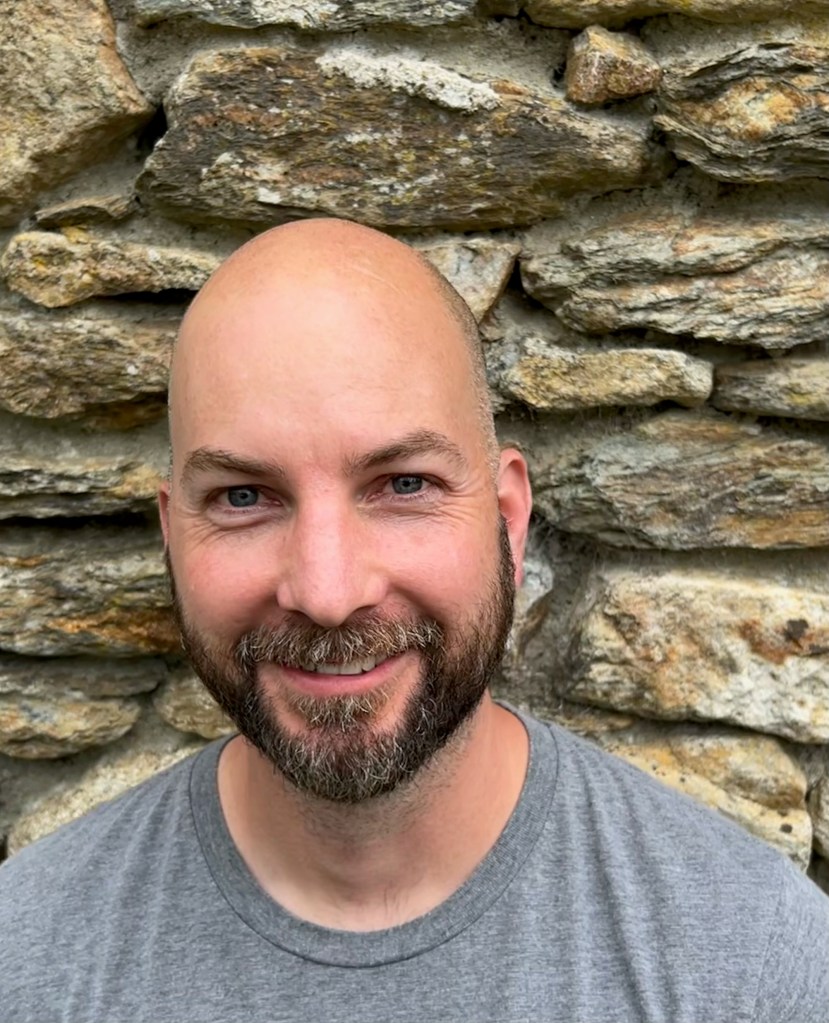
A former tradesman, Dan Murphy teaches creative writing and literature in Greater Boston. His individual poems have appeared in national and international literary journals. He lives with his wife, their two daughters, and a dog on a modest “estate.”
April 2025

Grace Maxwell
Thank you for being with us today, Mr. Murphy. I really enjoyed reading your collection, Estate Sale. To begin, I’d like to know what got you into poetry specifically?
Dan Murphy
Well, thank you for having me.
Poetry was something that I started writing during my senior year of high school, and I had a really great teacher—his name is Lou Bernieri—and he had this course that wasn’t quite a workshop, but was mostly a free write course. And that course was my first entry into creative writing, and from there it took off. I hadn’t always thought about becoming a poet per se, but I was always writing, always writing poetry, and returning to it at different times when I could. It wasn’t until many years later that I actually got my MFA.
GM
I see. So, something I noticed in your collection that I really liked is the two languages you use. I put the second language into Google Translate, so correct me if I’m wrong, but Google Translate said it was Irish. Is that right?
DM
It is. Yeah, yeah.
GM
Okay, so what’s the deal with that? Were you expecting your audience to put it in Google Translate and get the English version, or did you just see the beauty of the Irish language and not care too much if your audience knew what they were reading? What was the thought process there?
DM
Yeah, I mean, I do like the idea of the limits of understanding that we have when we’re reading poetry—that we’re not always meant to understand it completely, that there is a bit of mystery to it. So, that was part of the project: writing in two different languages and having them not entirely adjacent to the translations within. The collection was as much about foregrounding the Irish and not giving supremacy to the English language, which is, obviously, my first language. That was intentionally jarring as a kind of prelude to the rest of the collection. That very first poem in Irish deals with a lot of the themes that come up later on in the collection as well.
GM
And I also noticed that the very first poem written in Irish is also seen later in the collection in English. I found that very interesting. Can you speak to the choice to repeat the poem in the two different languages?
DM
Yeah, so I think it would be really frustrating for a reader. Look, there are, I think, somewhere in the range of tens of thousands of native Irish speakers who actually communicate in Irish every day as their first language, and that’s not a very wide audience on the global scale. So, I think it’d be very frustrating for an audience to read a book and not have that connection to the words on the page somewhere and somehow. And I think that, for me, writing in Irish is about seeing the world in a different way. There are certain limitations that I have with my Irish, so naturally, when writing in it, you’ll notice all the poems in Irish are in the present tense, for instance. I know the past tense, but there is a really simplified way of writing, and that created almost the form in itself for the writing of the translations for the English poems as well. I think of that balance, you know, I want there to be some kind of redeeming quality at the end of having read the collection, and obviously for readers to see the direction that I’m trying to push these poems in.
GM
So, is that why the Irish version of “Holding Snow” was the very first poem of the collection, and then the English version was way later, so that there was a resolution at the end?
DM
Yeah, absolutely. I think, too, I was thinking about them and their resonances to each other. When we’re putting together collections, we’re trying to see the ways in which connections are being made, but also, when you put one poem aside of another, how it might grow in resonance. And that poem later on felt like it deserved a place there.
GM
That’s awesome. So, your collection is filled with often haunting images that tap into both personal and cultural history. How do you, as a writer, navigate the balance between personal memory and the larger cultural narrative in your work?
DM
Yeah, that’s a great question. I think personal experiences are just a starting point. And hopefully, they become the start of a conversation or the start of an idea about something broader. And I hope that my poems aren’t stuck on the personal, right, that underneath, they’re pointing to something perhaps universal, but at least something broader in terms of their project. So, the “personal” that we find in the poems hopefully speaks to some idea that reaches beyond that first impulse.
GM
So, in poems like “Estate Sale,” there’s a clear tension between holding on to the past and letting go of it. How do you see the act of remembering versus the act of moving forward, both in your writing and in life in general?
DM
Yeah, that’s a loaded question. I think memory is, as it’s been said elsewhere, always particular to the perspective whose memory is being recalled, so it’s fallible in that way. There’s something important I feel like our consciousness is telling us when we do remember something, right? I don’t often remember a whole lot, so when there’s a memory that emerges or keeps reemerging, it feels important, and then it’s my project as a poet and as a writer to see why that is, to ask why is it that I’ve recalled this particular thing in the way that I’ve recalled it. And that’s memory on a personal level.
There’s something about historical memory, and this, I think, relates more to how we’re trying to be in the world. Obviously, there are the ways in which historical memory gives us some sense of what’s possible, what can happen, and the patterns, whether it’s political or otherwise, that we see repeating. So, in some ways, it’s a way of understanding how to proceed, either personally or as a collective, as a society, and that’s why we try to recall these things.
GM
Oh, certainly.
I would also love to know your process when creating poetry. For this collection, which was a very big collection, would you say you wrote everything specifically knowing it was going to go together? Or did you pull from some past work, or did you just have a bunch of pieces and think, “Oh, these would go great together”?
DM
You know, initially, you start, and you’re just writing poems, and you’re seeing what turns up. In an MFA program, you might be writing poems weekly, and you just have to get a poem out. And poems under that type of pressure are always interesting because sometimes you surprise yourself. What are the things that keep coming up in one way or another?
And then there are poems that take years to write. There are poems that emerge out of obsessions, right? Certain subjects and things that you want to say, that you want to get right, and so you keep writing the poem, it’s different every time, and it’s not quite right, but hopefully, eventually, you’ll get there.
So, you keep stacking up all these poems until you start thinking, “Oh, I should start thinking about a book.” And then, as you’re bringing them together, you start to see themes, you start to see which don’t belong, either tonally or thematically, and you’re trying to find a thread, however tangential. And then you get to this place where you have maybe two–thirds or three–quarters of your manuscript, and you begin to feel or understand what the absences are, and to some extent, try to write in that direction. But that’s always a difficult thing to do when you have that set idea of “This is what I need here,” the poem can have a way of getting further and further away from you.
So, that’s the difficult part of the process—as you’re getting closer, things sometimes feel like they’re getting farther away. But that’s a timeline of this particular collection. For a collection I’m working on now, I started with a really overarching idea for it, and now, it’s about seeing the ways in which I can fulfill that grand notion.
GM
So, would you say that once you have the first chunk, and then you have to fill in the gaps, do you feel limited as a writer? Because you start with this overarching theme, but then through your work, you can tell that there are even more specific, intertwined themes. So, do you feel more limited, or does that not bother you because you were already writing like that anyway?
DM
Yeah. I mean, I think there are some ways in which it is limiting, but I think something like form is always counterintuitive. Form is a useful tool to be able to break out of your logical part of the brain, saying, “This is how you should be writing,” for instance. So, if you start with an idea of “This is the subject matter or idea that I want to be dealing with,” and then start trying out different forms, it’s kind of this iterative process. It’s not unlike design-based thinking, where you keep trying to do this thing in different ways and see what works—see if anything works. And then, maybe you go back to the drawing board. Nothing worked, but you’ve at least progressed in some way; you know you’ve gotten closer to what it is that you’re after.
GM
Well, speaking of form in “Estate Sale” specifically, that poem is just all over the page—it descends and skips and jumps around the page. I actually took a poetry class, and my professor recommended that I do the same thing to one of my poems, but I didn’t really get it. And, certainly, I am not a professional poet; so, why do you, as a poet, sometimes write poems all over the page rather than the traditional left-to-right, line-by-line kind of writing?
DM
So, I have a friend who calls it “stepped caesurae,” and that’s just kind of how it looks on the page. I think there may be four poems in the collection that follow this. It looks haphazard on the page, but it’s a kind of form. I think part of it is about how I want the reader to receive these lines on the page, right, visually. You know, there are natural pauses when you have spaces in different positions. When there’s a wider blank space, maybe between lines or between words, there’s a sense that there’s maybe something absent there. And so, there’s a bit of that—how I want the poem to be received visually.
But then, there’s also how the form reflects some sense of the subject matter in the body of the poem. And in “Estate Sale” in particular, it’s arranged, maybe visually, how you might find objects at an estate sale, right? There’s a bit of the physical environment, and then there’s also the emotional environment, which is, I think, also scattered in some ways—which is also bouncing between different ideas and different memories and how you can reflect that then, in how things look spatially right, on how things look in a concrete way.
GM
That’s very interesting because the form did make me slow down and really absorb every word to make sure I wasn’t skipping anything. So, that’s very interesting. That’s for the audience, and how they read it, and how you want them to interpret it.
DM
Yeah, absolutely.
GM
So, I want to backtrack a little because you said that sometimes poems can take years to be fully formed. And as you’re writing, you think, “Oh, that’s not good enough.” And as a creative writer and as a student dealing with academic work, I find that to be so true. So, how do you decide when a poem is done? Because I’ve heard “A piece is never done, just due.” So, how do you decide when it’s done?
DM
Yeah, it’s finished, I guess, when I don’t want to work on it anymore. There are some poems that are quote “done,” but they’ll never see the light of day, right? I won’t send them out anywhere, or they just remain in the computer, in that folder—it might be labeled “Poems That Will Never Get Sent Out,” and it might just stay there. I think there is this balance between trying to maintain the energy and the impulse behind the original, whatever that original is. And it can be the case that you over-revise something, especially if it’s over a number of years that you’re in this, you’re another person, and you’re now placing that other person’s ideas about style and poetry and just worldview onto this thing that was, and should in some ways remain, that other you. And that’s especially when writing the poem spans over several years, that’s a thing to be careful of.
But I think there’s also that sense that there are poems that you’ve written, and it’s like, “Wow, I really like that idea. I’m not sure about the execution, and I really would like to have that poem mean something to me now in this time and place.” So then, it somehow becomes possible to reopen things and take a fresh look at them. There’s something about the imperfection of any collection of poems, right? Whether it’s a printer’s error or poems that you know you just have to let go of and recognize that there are great poets out there who have poems within their work that might not be able to stand alone, right? I think there are poems in my collection that don’t stand alone by themselves but that serve a greater purpose; they are these little sacrifices you put into the collection because they say something larger about the collection. As a whole, they have some kind of additional resonance when in context with these other poems. And so that’s all to say, there’s no right moment to send a poem off. It’s just by feel, it’s all by feel.
GM
I can understand that. Yeah, that scares me, but I understand it.
So, do you recall what the oldest poem is in this collection, like the poem you started at the very beginning, maybe years ago?
DM
Yeah, I think the poem about my cousin, called “Still.” It’s a poem where I inhabit different people in my life and their experiences as well as my own. I think that was a poem that might be twenty years old. And that’s one that I went back to, and I felt was an important poem. It’s much changed from its original, but I think the essence of it is still there.
GM
So, obviously, the collection is from your point of view. But I did see your family pop up quite a bit. Would you say that your family is your muse, or just your life in general? Or do you even have a muse?
DM
Yeah, I mean, I’m a very simple person, and I think the things I write about are just always, or almost always, ideas that pop up from everyday life. And, you know, part of that is family and extended family and that sort of thing. Whatever I can remember, really, these days, that’s the starting point. And I’d say a fair amount of my poems start with this uneasiness of what it is that I’m writing about, and then they find what’s important about this thing that I’m interested in. So, eventually I might get there, and when I do, I can go back on that poem and revise with this new idea—this satori in mind. I can see where the poem was headed before I knew where it was headed.
GM
Well, speaking of everyday life, can you talk about your process for finding poetry in these everyday experiences?
DM
Yeah, I mean—and this is something I tell my students—just to take notes vigorously. I use the notes app on my phone, and I’ll jot down phrases, images, and ideas that come to me because I will forget them if I don’t. And I try to tell students, too, that the same impulse that’s behind taking out your phone and trying to take a picture of something—that’s the same kind of impulse to write down an idea. And so, if you see something interesting in the world, instead of taking a picture, being able to write in a note or two that captures that in some way, that you can store away and save for later, I think that’s a helpful thing. Now, when you go back, some of it looks like gibberish, and if somebody were to read it, it looks like you’re a crazy person, but I think that’s the start for my process. If I’m sitting down and I have time to write, I can just go into the notes app, and I can see the most interesting thing, the thing that I most want to write. I have a room, a reminder of it, and I can jump in right there.
GM
That’s an interesting process.
So, several of your poems include animals in significant roles. How do you approach the symbolism of animals in your work? And what do they represent in the context of your larger theme?
DM
Yeah, well, I’m very interested in how humans relate to the world, and part of that is necessarily about how we relate to other animals. You mentioned we have some wolves in the collection. There’s a poem that didn’t make it in the collection, but it’s about the elephants that were roaming in China a couple of years ago, that were disturbing all sorts of communities. But again, it was this kind of reaction to being enclosed in a preserve unnaturally, right, that they were looking for more space to roam.
So, I try when I’m writing specifically about animals and in the context of the natural world not to assign to them human characteristics or human ideals or human beliefs, but rather to show them in context, in some ways, how we’re destroying the world some ways, how we’re forgetting how to be in the world, to show in some ways what’s being lost. So, there’s the poem about a hummingbird; it starts with this thing that I noticed looking out the window—a hummingbird attracted to the red glow or tint of my taillight—and for me, that immediately went to all these things in terms of the lost habitat, right? How unnatural that is in context. And so, those are some of my concerns. In the book, there’s quite a bit about the natural world and what we’re doing to it. So, I hope that answers the question.
GM
Absolutely. Yeah. So, there’s a recurring exploration of family and ancestry, and I’m looking at specifically ancestry for this question. Do you see your writing as a way of preserving their legacies?
DM
I do. You know, my father reads widely. He’s very proud of his Irish heritage, and he was always immersed in it for as long as I can remember. So, we grew up as even young children hearing about colonialism and imperialism, and he would talk to us about the ways in which the Irish people were essentially colonized for hundreds of years. On my mother’s side, I’m Slovenian, and as I’ve talked about elsewhere, it’s not lost on me that in both my parents’ time, the languages of Slovenian and Irish were lost. I remember my father telling us stories about how he’d sit on his grandfather’s lap, and his grandfather would be talking to him in Irish, telling him stories, and making up poems in Irish. And on my mother’s side, my grandfather would only speak Slovenian to his mother, my great-grandmother. She didn’t speak English, and so both those languages were kind of lost in my parents’ lifetimes, and I believe deeply that these different languages have encoded within them certain cultural beliefs, certain ways of being in the world. And it’s not just about reclaiming that heritage, but it’s also about understanding those ways of being in the world, too, right? Those are losses, but I can keep those active, hopefully, and pass some of this on to my own children.
I’m thinking specifically of a word in Irish—when you talk about, for instance, money: a chuid, airgead, which could mean his share of silver. So, everything, when you’re talking about different possessions, is a share of something, so “What’s your share of this?” or “What’s your share of that?” And I feel like that’s such a different cultural standing than “How much money do you have?” or “How much money do you owe me?” So, that’s just one example of how languages can hold something of cultural value. We see it with indigenous languages—a certain way of treating the natural world. It’s completely embedded in it.
GM
So, you said that you discovered your love of poetry during your senior year. That’s kind of late, not in life, but at that point, you’ve probably already thought about college or trade school or a career, and you said that it wasn’t until years later that you got your MFA. So, would you say that when you discovered your love of poetry, you thought, “This is what I want to do, but it’s kind of too late, I’m already on this other path,” or did you think it wouldn’t work out as a career at the time? Obviously, it all worked out in the end, but what was your thought process at the time?
DM
So, my dad, I think, graduated from college from when he was 30. He was a carpenter. He worked as a maintenance man. He had all these different jobs. And you know, in some ways my path was similar. So, when I was a senior in high school, I didn’t apply to college. I worked in a lot of different jobs. I worked in the trades. I worked as a bartender. I worked as a mover. I never had expectations of what I would do by a certain time. My wife will tell you, I don’t plan, I’m not good with schedules, and so, I was free to just see where things had taken me.
So, there was no pressure on when to write and when not to. And I think that was really great in terms of these jobs that I was doing. They were all kind of like apprenticeships for writing, right, like here are all these people that you’re going to meet from different walks of life in all sorts of different contexts, and it really helps develop your understanding of how people relate to each other, what motivates them, what their interests are. It certainly gives you a greater sense of the other, right? Recognizing that there are these things that I think in my head, and then I can understand that lots of other people are thinking some of these same things as well.
GM
I completely understand that approach.
Alright, this is my last question. So, I know you mentioned that you have a new collection that you’re working on. Are we going to see any similar themes, or is it all brand new? Can you tell us a little bit about it?
DM
Yeah, so I will say it’s in progress. But some of the themes that I’m thinking about are related to suburbanization, to kind of eco health, and, I’d say, the absurdity in some ways of American life at the moment. So, I’m hoping, and certainly, I think, the poems are pushing in that direction of a more obvious or more overt critique of the times we’re living in.
GM
Alright. Well, I’m very excited, and I’ll have to check that out whenever it’s finally released. I’ll be on the lookout.
Well, thank you so much for coming today and being with us, and thank you for letting me pick your brain. I really enjoyed the Estate Sale collection. When does it officially release?
DM
Yeah, so it will be out in June this year. It’s still a few months away.
GM
Well, great. This is some great advertising, then.
DM
Yeah, thanks so much, Grace. I appreciate it.
 Panhandler Books